
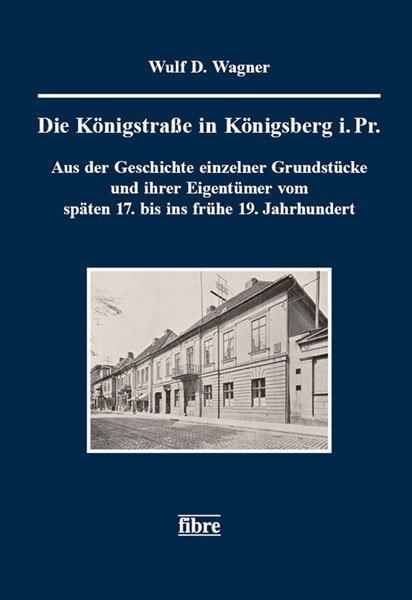
Die Königstraße in Königsberg i. Pr.
At the beginning of the 17th century, the fields to the north-east of Königsberg’s old town were home only to the ducal-electoral Schirrhof, the Jägerhof and a few farmsteads. From the 1660s onwards, plots of land along a country lane were increasingly built on by nobles and townspeople. This is how what later became Königstraße in the Neue Sorge district came into being. Drawing on Königsberg’s house registers and other archival records, Wulf D. Wagner traces the development of the street and the history of its 101 plots from the late 17th to the early 19th century. The street was characterised by the coexistence of all social classes: the noble widow lived next to the baker’s wife, the professor next to the innkeeper, the surgeon next to the landscape gardener, and the royal official next to the wealthy cartwright. In between, Countess Dönhoff owned a large garden, the Counts of Dohna leased out small plots, a Kalnein built a tenement house, a Bolschwing became a property speculator, and a linen factory went bankrupt. The Reformed community received their cemetery, and Frederick William I allowed the French Reformed congregation to build their church here. Thus, a stroll down the street brings Königsberg’s social diversity to life. City maps and previously unpublished plans from the 17th and 18th centuries enrich the volume, whilst postcards from around 1900 offer a glimpse of the architectural changes the street underwent during the late 19th century.
1. Auflage. Hardcover, Fadenheftung, 192 Seiten. Format: 174 x 245 mm.
Enthält Fotografien und Karten, tlw. farbig.
Erscheinungsjahr: 2023
Available in 2 to 4 working days.
Delivery within Germany is free of charge.
For deliveries within and out of the EU, we charge the shipping costs incurred.